

James McCord
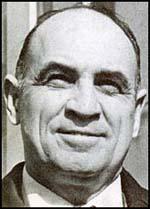
James W. McCord, the son of Marjorie (nee Welch) and James McCord Sr, a schoolteacher, was born in Waurika, Oklahoma, on 26 January 1924. The McCord's family originated in Scotland. His great-grandfather served in the Tennessee militia during the War of 1812. McCord's grandfather, James Allen McCord, was from Alabama and served in the Confederate Army. (1)
McCord joined the Federal Bureau of Investigation and worked in a special intelligence operation against German spies in the United States (1942-43). This was followed by a period in the US Army Air Corps (1943-45) during the Second World War. (2)
According to Robert D. McFadden of The New York Times: "Much about his background and early life is unknown. His C.I.A. work fell under national security restrictions, he often provided false or no information about himself, and his records were full of gaps and contradictions." (3)
McCord joins the CIA
After the war he settled in Texas, where his parents lived. After a brief return to the FBI, where he carried out counterespionage assignments, he joined the Central Intelligence Agency in 1951. His first task was identifying CIA employees whose left-wing pasts might prove embarrassing if Senator Joseph McCarthy discovered this information. McCord came into daily contact with the inner circle of Cold War Red hunters, including Lou Russell and Lee R. Pennington. According to McCord's friend, Alfred Wong, the Secret Service agent who helped install the taping system used by President Richard Nixon, he worked with E. Howard Hunt in the CIA's North Asia Command in 1954-1955. (4)
It is believed that as an operative McCord played a role in the Bay of Pigs invasion of Cuba in 1961, and developed ties then with E. Howard Hunt and Frank Sturgis and developed ties with other Cuban exiles. Michael Carlson has pointed out: "McCord later testified that he and Hunt had never met before Watergate, but that was easily disproved; their association went back even before the Bay of Pigs, in which Hunt was a major player." (5)
In October 1961 McCord became the CIA's senior security officer in Europe. Two years later he returned to CIA headquarters and in 1963 he became involved with E. Howard Hunt in an operation code-named "Second Naval Guerrilla". Hunt had been serving as acting chief of the CIA's Mexico City station during August and September. The operation was intended to coordinate a second attempt to invade Cuba, with a plot to assassinate Fidel Castro. Camps were established in Nicaragua and Costa Rica to train some 700 Cuban exiles. Some of the same CIA personnel that orchestrated the Bay of Pigs were involved in the new enterprise. The proposed plan was the invading army, led by Manuel Artime, would land in Cuba around May 1965, after Castro was assassinated. (6)
According to Enrique Ruiz-Williams, Hunt and McCord were his handlers during the Second Naval Guerrilla operation. Hunt was Ruiz-Williams' liaison to CIA headquarters, while McCord performed the same function with respect to the brigade veterans at Fort Jackson. There were "dozens of meetings and countless telephone discussions" between himself and the two CIA men, with the meetings taking place in Washington and New York. (7)
McCord was close to CIA director Richard Helms. The historian, Jim DiEugenio, met up with former CIA pilot Carl McNabb (also known as Steve Wilson): "He said that prior to the Bay of Pigs, he had been briefed at the Miami CIA station, since he was part of the aerial facet. He noticed that McCord was in the room and he was struck by how taciturn he was. Afterward, he asked the briefer who he was. He told him his name. He then added that he was Helms' Zap Man. McNabb later showed me the very old notes with this information recorded on it. I asked him what the term meant. He replied McCord was his liquidator." (8)
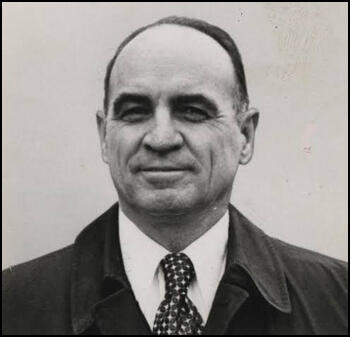
McCord and Hunt both retired from the CIA in 1970. After leaving the CIA McCord taught a security course at Montgomery Junior College. Later he established his own security consulting firm, McCord Associates, in Rockville, Maryland. He also founded Security International, a company that provided security systems and services. As John M. Newman later discovered, it was here where McCord teamed up with David Atlee Phillips to supervise the CIA's anti-Fair Play for Cuba Committee campaign, of which Lee Harvey Oswald had all the earmarks of being a component. (9)
According to Bob Woodward and Carl Bernstein who investigated McCord: "A native of the Texas Panhandle; deeply religious, active in the First Baptist Church of Washington; father of an Air Force Academy cadet and a retarded daughter; ex-FBI agent; military reservist… a family man; extremely conscientious; quiet, reliable." (10)
E. Howard Hunt joined the Mullen Company staff, having been placed there by Richard Helms, the CIA director, upon Hunt's alleged retirement from the agency. Hunt knew Caddy's mentor, William F. Buckley, who had worked under him as an agent for the CIA in Mexico City years earlier. (11)
Hunt recalls meeting Caddy for the first time in 1970 at the Robert Mullen Company. "Through CIA's placement service I was introduced to Robert Mullen, head of a small public relations firm in Washington…. The CIA placement officer had told me that the Mullen firm had "cooperated" with CIA in the past. This cooperation was identified as the firm's having established and managed a Free Cuba Committee for the CIA. So, I inferred that my CIA background would not prove a handicap to employment with Mullen as it had with several multinational firms." (12)
First Watergate Break-in
On 1 st January 1972, James McCord was appointed as the security coordinator for the Committee for the Re-Election of the President (13). It was officially, a fundraising organization of United States president Richard Nixon's 1972 re-election. In addition to fundraising, the organization was engaged in political sabotage against Nixon's opponents, the various Democratic Party politicians running in the presidential election. (14)
In 1972 G. Gordon Liddy presented Nixon's attorney general, John N. Mitchell, with an action plan called Operation Gemstone. Liddy wanted a $1 million budget to carry out a series of black ops activities against Nixon's political enemies. Mitchell decided that the budget for Operation Gemstone was too large. Instead, he gave him $250,000 to launch a scaled-down version of the plan. (15)
One of Liddy's first tasks was to place electronic devices in the Democratic Party campaign offices in an apartment block called Watergate. Liddy wanted to wiretap the conversations of Larry O'Brien, chairman of the Democratic National Committee. Liddy recruited McCord to help him with this. On 28th May 1972, McCord and his team broke into the DNC's offices and placed bugs on the telephones of O'Brien and R. Spencer Oliver, executive director of the Association of State Democratic Chairmen. The bug on O'Brien's telephone proved faulty, but Baldwin monitored two hundred calls on Oliver's telephone. (16)
It has been pointed out that Bill Haddad, a Democratic politician in New York sent a letter to his friend Larry O'Brien in Washington on 23 March 1972, warning him that his Watergate office might be a target for wiretapping. "I am hearing some very disturbing stories about GOP sophisticated surveillance techniques now being used for campaign purposes… The information comes from a counter wiretapper who helped me once in a very difficult situation in Michigan." (17)
O'Brien sent an aide, John Stewart, to New York to check on the information. Haddad arranged for his source, Arthur Woolston-Smith, to meet with Stewart. (Declassified CIA documents indicate that as early as 1954, Woolston-Smith was a representative of the Canadian Intelligence Service). Woolston-Smith told Stewart that Miami's Cuban community would be involved and that they were going to break into O'Brien's office to find evidence that the Democratic Party was receiving money from Cuba. (18)
Second Watergate Break-in
It is therefore believed that the bug on O'Brien's phone was simply removed after it was installed and that's why it did not work. It was therefore decided to return to O'Brien's office on 17 June 1972 to place a new bug on his telephone. Earl Robert Merritt, a member of Metropolitan Police Department, was told by one of his informants about the intended break-in. Merritt passed this information to Carl M. Shoffler who set up an entrapment scheme. His plan was to become the most famous detective in the world. (19)
Jim Hougan has raised questions why Shoffler volunteered for a second shift that night. This meant two eight-hour shifts back-to-back. "The following day was Shoffler's birthday. His wife and children had gone to Pennsylvania on the afternoon of 16 June to spend the weekend at Shoffler's parents' home. Shoffler was to join them that weekend to celebrate his birthday with his parents. Given the long journey in front of him, it seems odd that he chose to work a second shift on that particular night." (20)
Shoffler, who had been injured on duty some months before, was assigned to desk work on the evening of 16 June 1972. His shift ended at 10.00 p.m., but he voluntarily undertook a second shift, joining a plainclothes tactical unit cruising the streets in the early-morning hours. Shoffler was sitting with three other officers, in a parked police car, a minute from Watergate building when Watergate Security Guard Frank Wills found the second taped door and called the police for help. (21)
Frank Sturgis, Virgilio Gonzalez, Eugenio Martinez, Bernard L. Barker and James W. McCord were arrested at 2.30 am during a break-in into the Democratic Party headquarters at Watergate Office Building. When arrested Barker had his hotel key in his pocket. In his hotel room found a briefcase containing $4,600. The money was in hundred-dollar bills in sequential serial numbers that linked to the money found on the Watergate burglars. They also found two address books with the name "Howard Hunt" and details that he worked in the White House. (22)
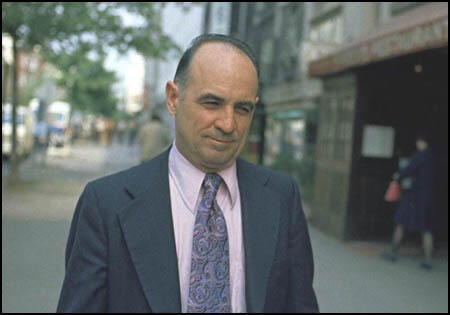
As soon as E. Howard Hunt had become aware of the arrests, he started making telephone calls: "My first was to lawyer Douglas Caddy… His sleepy voice didn't sound too happy. ‘Yes' he said. ‘Doug? This is Howard. I hate to wake you up, but I've got a tough situation, and I need to talk to you. Can I come over?' That was the beginning of Watergate – a scandal that would bring down a president and destroy my life in the process." (23)
Douglas Caddy later reported what Hunt said when he arrived at his house: "Hunt explained to me what had occurred inside the Democratic National Committee headquarters at Watergate culminating in the arrests of James McCord and the four Cuban-Americans. I was appalled at what I heard and immediately realised the dire threat it posed as a criminal case to the survival of the Nixon Administration…. From my apartment Hunt telephoned Gordon Liddy… Shortly before 5 a.m. both Hunt, in my apartment, and Liddy, on the telephone with me, retained my services as their attorney to represent them and the five arrested burglars in the case." (24)
G. Gordon Liddy now telephoned Jeb Stuart Magruder, the deputy director of the Committee to Re-Elect the President (CRP) to tell him, "That five of our men had been arrested in DNC headquarters" and that he should tell John Mitchell, the Attorney General, about what had happened. Mitchell then gave permission for Liddy to tell Richard Kleindienst, the Deputy Attorney General "to help get McCord out of jail right away – before it's found out who he really is." Kleindienst refused to help and so Liddy returned to his office and continued to destroy all the records of his illegal actions. (25)
The Watergate burglars first appeared in court for their arraignment on Saturday, June 17, 1972, just hours after their early-morning arrest. The only journalist in the courtroom was Bob Woodward. He later wrote about his attendance at the courtroom. "One person stood out. In a middle row sat a young man with fashionably long hair and an expensive suit with slightly flared lapels, his chin high, his eyes searching the room as if he were in unfamiliar surroundings." Woodward sat down next to him and asked if he was in court because of the Watergate arrests. "Perhaps," the man said. "I'm not the attorney of record. I'm acting as an individual." He then said his name was Douglas Caddy. (26)
Douglas Caddy later recalled: "As the five were being arraigned in court late that Saturday, a Washington Post reporter named Bob Woodward, himself a former military intelligence agent assigned to the Nixon White House, sought me out. I found myself in the awkward position of providing evasive answers, because at that point few persons knew of the involvement of Hunt and Liddy, and anything I might say could place them in legal jeopardy." (27)
During the court hearing James McCord was asked by the judge about his current employment. He replied that he was a security consultant and then went on to say he had previously worked for the CIA. As soon as Woodward heard this, he knew he had an interesting news story. Why had McCord revealed his association with the CIA? Is it possible that Woodward had been told by someone in the CIA that he was going to give that information that morning? (28)
Woodward returned to the office with news of McCord's statement. The city editor, Barry Sussman, decided that the story should appear on the front page of the newspaper. The first paragraph of the story read: "Five men, one of whom said he is a former employee of the Central Intelligence Agency, were arrested at 2.30 a.m. yesterday in what authorities described as an elaborate plot to bug the offices of the Democratic National Committee here." (29)
Several people who have researched the case believe that it was Carl M. Shoffler, a detective in the police department's intelligence unit, who had arrested the burglars, was the man who tipped off Woodward. In his book, Secret Agenda: Watergate, Deep Throat and the CIA (1984) Jim Hougan points out that both H. R. Halderman (The Ends of Power) and Carl Oglesby (The Yankee and Cowboy War: Conspiracies and Dallas to Watergate and Beyond) both believed that it was Shoffler who told Woodward about the Watergate burglars appearing in court that morning. (30)
E. Howard Hunt was also highly suspicious of Carl Shoffler. In an interview with Time Magazine he asked why Shoffler was in a position to arrest the Watergate burglars on 17 June 1972: "There were just too many fishy things that occurred. What was the Mod Squad (Shoffler's group) doing out on the street some two or three hours after they were supposed to be off duty? McCord was an electronic hitchhiker who shouldn't have been allowed on our operation… There were just too many things that went wrong for them all to be a coincidence." (31)
Captain Edmund Chung was Shoffler's commanding officer at Vint Hill Farm Station in Virginia. Chung claims that he had dinner several months after the Watergate break-in. According to Chung, Shoffler told him that the arrests were the result of a tip-off and that he had been in contact with Alfred C. Baldwin prior to the break-in. Shoffler added that if he ever made the whole story public, "his life wouldn't be worth a nickel". Shoffler later denied the story and suggested that Chung was a CIA agent. (32)
The Motives behind Watergate
There are two important questions that need to be asked about the Watergate break-in. The first is what were the motives behind the crime. Russ Baker has argued: "If, as it appears, Watergate was indeed a setup, it was a fairly elaborate covert operation, with three parts: 1) creating the crime, 2) implicating Nixon by making him appear to be knowledgeable and complicit in a cover-up, and 3) ensuring that an aggressive effort would be mounted to use the 'facts' of the case to prosecute Nixon and force him from office." Baker claims that all those who played an important role in the downfall of Richard Nixon had CIA connections - John Dean, E. Howard Hunt, Frank Sturgis, Virgilio Gonzalez, Eugenio Martinez, Bernard L. Barker, James W. McCord, Alexander P. Butterfield, Jeb Stuart Magruder and Leon Jaworski. (33)
As Richard Nixon later pointed out in his autobiography: "Press reports soon indicated that Hunt and McCord and their confederates were attempting to photograph files, bug the telephones, and arrange electronic monitoring of the Democratic Committee. I could not understand why anyone would think there was anything to be gained from such a half-baked and technically difficult operation that would possibly warrant the risks involved." (34)
Nixon had similar thoughts when he first read about the Watergate burglary in the Miami Herald while vacationing in Florida: "It sounded preposterous. Cubans in surgical gloves bugging the DNC! I dismissed it as some sort of prank... The whole thing made so little sense. Why, I wondered. Why then? Why in such a blundering way... Anyone who knew anything about politics would know that a national committee headquarters was a useless place to go for inside information on a presidential campaign. The whole thing was so senseless and bungled that it almost looked like some kind of a set-up." (35)
Nixon's Chief of Staff, H. R. Halderman, was another person who could not see why the break-in had been organised by John N. Mitchell, G. Gordon Liddy and James W. McCord. "Mitchell, the campaign chairman, knew by June 17 that Nixon didn't need any political information, useful or otherwise, to defeat McGovern. He was about 64-36 in the polls, an unprecedented lead." (36)
Fred Thompson, the minority counsel to assist the Republican senators on the Senate Watergate Committee, later claimed: "In my opinion, we (the minority staff) had already determined that the CIA was aware of the activities of the Watergate burglars prior to the break-in and that it perhaps knew more than' that... In my mind, the question was becoming one of whether the CIA had been a participant in or a benign observer of the breakin, or, in view of the bungling of the burglary and the mysterious circumstances surrounding it, whether CIA ' operatives had perhaps sabotaged the break-in to weaken the White House and strengthen the Agency in its struggle for survival." (37)
Helms, Nixon, Haldeman and Thompson are right; the operation does not make any sense at all. The second question is even more important. Why was it done so badly? The operation involved several people who had successfully carried out other intelligence operations. It was also in direct contrast to other Nixon dirty tricks campaigns. Why did the burglars leave so many clues behind that made it inevitable that they would be caught and at the same time provide links to the Nixon administration?
Here is a list of some of the mistakes they made in the Watergate operation that led to the resignation of Richard Nixon:
(i) The money to pay for the Watergate operation came from CREEP. It would have been possible to have found a way of transferring this money to the Watergate burglars without it being traceable back to CREEP. For example, see how Anthony Ulasewicz got his money from Richard Nixon. As counsel for the Finance Committee to Re-Elect the President, G. Gordon Liddy acquired two cheques that amounted to $114,000. This money came from an illegal U.S. corporate contribution laundered in Mexico and Dwayne Andreas, a Democrat who was a secret Nixon supporter. Liddy handed these cheques to E. Howard Hunt. He then gave these cheques to Bernard L. Barker who paid them into his own bank account. In this way it was possible to link Nixon with a Watergate burglar. (38)
(ii) On 22nd May 1972, James W. McCord booked Alfred C. Baldwin and himself into the Howard Johnson Motor Inn opposite the Watergate building (room 419). The room was booked in the name of McCord's company. During his stay in this room Baldwin made several long-distance phone calls to his parents. This information was later used during the trial of the Watergate burglars. (39)
(iii) On the eve of the first Watergate break-in the team had a meeting in the Howard Johnson Motor Inn's Continental Room. The booking was made on the stationary of a Miami firm that included Bernard L. Barker among its directors. Again, this was easily traceable. (40)
(iv) E. Howard Hunt oversaw photographing documents found in the DNC offices during the first break-in. The two rolls of film were supposed to be developed by a friend of James McCord. This did not happen and eventually Hunt took the film to Miami for Bernard L. Barker to deal with. Barker had them developed by Rich's Camera Shop. Once again, the conspirators were providing evidence of being involved in the Watergate break-in. The developed prints showed gloved hands holding them down and a shag rug in the background. There was no shag rug in the DNC offices. Therefore, it seems the Democratic Party documents must have been taken away from the office to be photographed. (41)
(v) G. Gordon Liddy drove his distinctive Buick-powered green Jeep into Washington on the night of the second Watergate break-in. He was stopped by a policeman after jumping a yellow light. He was let off with a warning. He parked his car right outside the Watergate building. (42)
(vi) After the first break-in Alfred C. Baldwin and James McCord moved to room 723 of the Howard Johnson Motor Inn to get a better view of the DNC offices. It became Baldwin's job to eavesdrop the phone calls. Over the next 20 days Baldwin listened to over 200 phone calls. These were not recorded. Baldwin made notes and typed up summaries. Nor did Baldwin listen to all phone calls coming in. For example, he took his meals outside his room. Any phone calls taking place at this time would have been missed. It has been described as "one of the sloppiest telephone surveillances ever undertaken". (43)
(vii) It soon became clear that the bug on one of the phones installed by McCord was not working. As a result of the defective bug, McCord decided that they would have to break-in to the Watergate office for a second time. However, the FBI reported that the second wiretap placed on O'Brien's telephone was nothing more than "a little toy" that didn't have the range to reach across the street where the receivers were installed. (44)
(viii) The burglars then met up in room 214 before the break-in. G. Gordon Liddy gave each man between $200 and $800 in $100 bills with serial numbers close in sequence. McCord gave out six walkie-talkies. Two of these did not work because they had dead batteries. (45)
(xiv) McCord taped the 6th, 8th and 9th floor stairwell doors and the garage level door. Later it was reported that the tape on the garage - level lock was gone. Hunt argued that a guard must have done this and suggested the operation should be aborted. Liddy and McCord argued that the operation must continue. McCord then went back and re-taped the garage-level door. Later the police pointed out that there was no need to tape the door as it opened from that side without a key. The tape served only as a sign to the police that there had been a break-in. McCord told Barker and Martinez that after the break-in he removed the tape on all the doors. This was not true and soon after midnight the security guard, Frank Wills, discovered that several doors had been taped to stay unlocked. He told his superior about this, but it was not until 1.47 a.m. that he notified the police. (46)
(x) When arrested Bernard L. Barker had his hotel key in his pocket (314). This enabled the police to find traceable material in Barker's hotel room. When E. Howard Hunt and G. Gordon Liddy realized that the burglars had been arrested, they attempted to remove traceable material from their hotel room (214). However, they left a briefcase containing $4,600. The money was in hundred-dollar bills in sequential serial numbers that linked to the money found on the Watergate burglars. (47)
(xi) Police took an address book from Bernard L. Barker. It contained the notation "WH HH" and Howard Hunt's White House telephone number. Police took an address book from Eugenio Martinez. It contained the notation "H. Hunt WH" and Howard Hunt's telephone number. He also had cheque for $6.36 signed by E. Howard Hunt. (48)
(xii) Alfred C. Baldwin told his story to a lawyer called John Cassidento, a strong supporter of the Democratic Party. He did not tell the authorities but did pass this information onto Larry O'Brien. The Democrats now knew that people like E. Howard Hunt and G. Gordon Liddy were involved in the Watergate break-in. (49)
As Jim DiEugenio has pointed out: "If not for James McCord, would there have been a trial at all? As most analysts of the June 17, 1972 final break-in have noted, there was something odd about the way the burglars were caught. McCord had taped the locks on numerous doors to keep them open during the break-in. The security guard, Frank Wills, had found these doors and removed the tape. When the burglars entered the building at about 1:10 AM, they found a previously taped door that was now stripped. McCord then conferred with higher-ups Hunt and Liddy. According to everyone but McCord, it was he who insisted on not aborting the mission. The door was retaped. But after McCord entered the building, he told his low-level cohorts that he himself had removed the tape on the doors. This was not true." (50)
One of the chief investigators for the FBI on the Watergate case was Angelo Lano. He told Shane O'Sullivan that he thought the Watergate break-in was a set-up: "You've got a guy who's expert in key entry, burglary (Virgilio Gonzalez). Why did they have to put the tape back on? You put the tape on one door; it wasn't necessary to put it on six doors. There's always been a question in my mind about the response of the police department - 2:30 in the morning - the placement of the items in the hotel room, the tape. To this day I still think that one of those guys tipped off the police department and it was either Hunt or McCord." (51)
Hush Money and the Watergate Trial
Two weeks after the Watergate arrests Douglas Caddy began receiving phone-calls from a man who called himself Mr. Rivers. The purpose of the calls was the request for Caddy to pay "hush money" to those involved in the Watergate break-in. On 6 July 1972, Caddy told Rivers he was unwilling to carry out the task and did not want him to contact him again. Caddy later found out that Rivers was Anthony Ulasewicz, a former New York City detective who carried out numerous assignments for the White House. (52)
On 20 July, E. Howard Hunt began to threaten the White House with public disclosure of his other secret activities in the Special Investigative Unit unless he was paid off. According to Hunt's biographer, Tad Szulc, he sent a message, saying "the writer has a manuscript of a play to sell," via Douglas Caddy, to be passed on to the White House. Caddy gave this message to Paul O'Brien, an attorney for the Committee to Re-Elect, who in turn, passed it on to John Dean. (53)
In October 1972, James McCord got a call from his attorney, Gerald Alch, who wanted to arrange a meeting about the case. According to McCord, Alch's opening words were, "I have just come from Bittman's office (Howard Hunt's attorney William Bittman). Nobody gets up on that (witness) stand during the trial. In return, they will get executive clemency, money while in prison and rehabilitation afterwards." McCord refused the deal. "I went over my concerns that the whole business had the appearance of a control mechanism to keep the men quiet prior to the Nixon election by the use of money as a weapon and tool." (54)
A few days later, McCord wrote to Jack Caulfield at the White House. McCord stated that if Watergate was dumped off on the CIA and Richard Helms was fired, "every tree in the forest will fall. It will be a scorched desert. The whole matter is at the precipice right now. Just pass the message that if they want it to blow, they are on exactly the right course." (55)
The objective of paying "hush money" was to ensure that the men pleaded guilty and did not give evidence against the men who arranged for the Watergate break-in to take place. However, McCord was not willing to take the money from this source because he did not want to help Richard Nixon to win the 1972 Presidential Election. This reinforces the idea that McCord wanted the Watergate break-in to fail and the main objective was to bring down Richard Nixon. This was the view of H. R. Halderman, Nixon's Chief of Staff, who wrote in The Ends of Power (1978) ) that the Watergate operation made no sense: "Nixon didn't need any political information, useful or otherwise, to defeat McGovern. He was about 64-36 in the polls, an unprecedented lead." Haldeman was convinced that McCord wanted to be arrested and that he was in the pay of either the Democratic Party or the CIA. (56)
One of the reasons that McCord might have been unwilling to take John Dean's money was that he might have been well rewarded by the CIA to get Nixon to resign. When he was arrested, McCord met Garey Bittenbender in the police station. Bittenbender was the police officer who served as McCord's liaison between the CRP and the police Intelligence Division. They had a brief conversation and McCord told Bittenbender that the Watergate break-in was "a CIA operation". (57)
Soon after the Watergate break-in James McCord destroyed a large number of documents that he kept in his home safe. Also present during the fire was Lee R. Pennington. At the time Pennington was director of the Washington office of the ultraconservative American Security Council. He was also, and had been for more than fifteen years, a contract agent of the CIA Security Research Staff. Pennington said that he helped McCord destroy every shred of paper that was found in McCord's office. (58)
The director of the CIA, Richard Helms, also decided to erase all tapes and burn all transcripts of conversations secretly recorded on what has been described as the CIA's "central recording system". More than four thousand pages of recorded conversations were destroyed, obliterating the behind-the-scenes record of Helms's six and a half years as DCI. Senator Mike Mansfield had ordered that all materials having to do with the Watergate affair be preserved, pending the Senate's scheduled hearings on the subject. Helms insisted that none of them had anything to do with the Watergate affair. "Who in the public can make an allegation that there were any tapes that were Watergate-related?" Lucien Nedzi replied: "The problem is, if the shoe was put on the other foot, how can you prove they weren't Watergate-related?" (59)
If McCord was unwilling to take the money, Hunt and the other burglars were willing to be rewarded for their silence. Rivers (Ulasewicz) had also been in contact with William Bittman, the lawyer who had agreed to represent E. Howard Hunt and supplied him with $25,000 for his legal costs. Rivers had not contacted Hunt directly because he assumed his telephone had been tapped by the FBI. Rivers eventually contacted Hunt's wife, Dorothy Hunt, via a phone booth in Potomac Village, and she was asked for an estimate of each arrested man's monthly living expenses and attorneys' fees, including those of Hunt and Liddy. The following day, she gave the amount to Rivers, who replied, "Well, let's multiply that by five to cut down on the number of deliveries." (60)
John Dean was giving the job of arranging the payment of "hush money". This money was given to Dorothy Hunt. (61) According to Tad Szulc, Hunt's biographer, Hunt collected over $200,000 from the White House over a short period of time. (62) In his book, The President's Private Eye (1990), Anthony Ulasewicz, admitted that he had was the man supplying the money to Dorothy Hunt. "She (Dorothy Hunt) started calculating everybody's needs and came up with a minimum figure of $3,000 a month, but as she didn't want to worry about a monthly delivery from the post man, it was better, she said, to get a big chunk up front to relieve the pressure on everybody. ‘So let's start with $10,000 or $15,000 apiece to get this thing off the ground,' she said. She wanted the advance to cover five months of living expenses. She said Barker, Sturgis, Gonzales, and Martinez needed at least $14,000 apiece and that Barker needed another $10,000 for bail, $10,000 more under the table, and $3,000 for ‘other expenses.' Twenty-five grand apiece were needed for Sturgis, Gonzales, and Martinez's attorneys. I told Mrs. Hunt to slow down. Now she was talking about $400,000 or maybe $450,000. That wasn't even close to the amount Dean had told Kalmbach to raise when they met in Lafayette Park."
Ulasewicz claims he delivered a total of "$154,000 to Dorothy Hunt in four separate instalments: $40,000, $43,000, $18,000 and $53,000. She was never satisfied with the amount of money I gave her. She never believed that I didn't have (and didn't want) the power to determine the breadth of financial support she said was necessary to keep things afloat. Neither Kalmbach nor I knew whether she was delivering what those involved were supposed to receive. She kept telling me about Barker's problems down south; that he needed a lot of cash to keep the lid on things in Miami." (63)
On 8th December 1972, Dorothy Hunt had a meeting with Michelle Clark, a journalist working for CBS. Was she about to betray Nixon and the others involved in the cover-up? According to Sherman Skolnick, Clark was working on a story on the Watergate case: "Ms Clark had lots of insight into the bugging and cover-up through her boyfriend, a CIA operative. In the summer of 1972, prior to any major revelations of Watergate, Ms Clark tried to pick the brains of Chicago Congressman George Collins, regarding the bugging of the Democratic headquarters." (64)
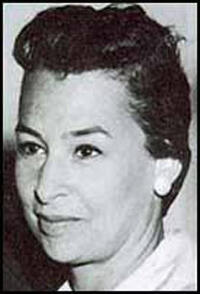
Dorothy Hunt, Michelle Clark and George W. Collins took the Flight 533 from Washington to Chicago. The aircraft hit the branches of trees close to Midway Airport: "It then hit the roofs of a number of neighborhood bungalows before plowing into the home of Mrs. Veronica Kuculich at 3722 70th Place, demolishing the home and killing her and a daughter, Theresa. The plane burst into flames killing a total of 45 persons, 43 of them on the plane, including the pilot and first and second officers. Eighteen passengers survived." Hunt, Clark and Collins were all killed in the accident. (65)
Just before Dorothy Hunt boarded the aircraft, she purchased $250,000 in flight insurance payable to E. Howard Hunt from an airport vending machine. In his book American Spy: My Secret History in the Cia, Watergate and Beyond (2007) Hunt claims he was unaware that his wife planned to do this. In the book he also tried to explain what his wife was doing with $10,000 in her purse. According to Hunt it was money to be invested with Hal Carlstead in "two already-built Holiday Inns in the Chicago area". (66)
H. R. Haldeman, who was fully aware of the negotiations taking place between Hunt and John Dean found this account difficult to believe. "Howard Hunt, supposedly so desperate for $122,000 he would threaten the White House with blackmail, should have been floating in money. He not only had had received thousands of dollars from Kalmbach and LaRue, but his wife had been tragically killed in an aeroplane crash, and the insurance Hunt collected was substantial. Mrs Hunt was carrying thousands of dollars in cash when her plane crashed enroute to Chicago. She was the paymaster for the burglars. But the burglars were in Washington and Miami. Why was she taking the money to Chicago? Hunt reportedly said he intended to lavish the cash in a real estate venture in Illinois. If he had enough money for real estate speculation, why was he so desperate for funds as we were led to believe?" (67)
As Peter Dale Scott has pointed out: "Of the more than a dozen suspicious deaths in the case of Watergate... perhaps the most significant death was that of Dorothy Hunt in the crash of United Air Lines in December 1972. The crash was investigated for possible sabotage by both the FBI and a congressional committee, but sabotage was never proven. Nevertheless, some people assumed that Dorothy Hunt was murdered (along with the dozens of others in the plane)." Howard Hunt saw his wife death as a warning and dropped all further demands on the White House and agreed to plead guilty to the Watergate burglary in January 1973. (68)
Negotiations were also carried out directly with James McCord. John Dean promised McCord an eventual government job and his family's financial security. McCord proposed that the trial could be dismissed if prosecutors introduced telephone conversations regarding Watergate that he had made to the Israeli and Chilean embassies - both of which were illegally wiretapped. Dean rejected this strategy. (69)
Daniel Schultz who represented Frank Sturgis, Virgilio Gonzalez, Eugenio Martinez and Bernard L. Barker claimed at their trial that they believed they were involved in a legitimate national security operation rather than in a crime, saying that his clients were "men convicted of a crime who are not criminals." Sturgis, Gonzalez, Martinez, Barker and Hunt all pleaded guilty and received the following sentences: Sturgis (1 to 4 years in prison); Gonzalez (1 to 4 years in prison); Martinez (1 to 4 years in prison); Barker: (18 months to 6 years in prison); Hunt (2½ years to 8 years in prison and fined $10,000). (70)
Seymour Hersh wrote an article in the New York Times claiming that all these men were receiving hush money and were pressured to plead guilty. Hersh speculated that the money came from the Committee for the Re-election of the President. Officials of the organisation "had acknowledged privately that they are unable to account for $900,000 in cash raised for President Nixon's 1972 campaign - far more than the $235,000 mentioned in court as the cost of the activities of the Watergate group." (71)
On 19 March 1973 James McCord sent a letter to Judge John J. Sirica where he argued: "Several members of my family have expressed fear for my life if I disclose knowledge of the facts in this matter, either publicly or to any government representative. Whereas I do not share their concerns to the same degree, nevertheless, I do believe that retaliatory measures will be taken against me, my family, and my friends should I disclose such facts." However, he was willing to state that: "(i) There was political pressure applied to the defendants to plead guilty and remain silent. (ii) Perjury occurred during the trial in matters highly material to the very structure, orientation, and impact of the government's case, and to the motivation and intent of the defendants. (iii) Others involved in the Watergate operation were not identified during the trial, when they could have been by those testifying." (72)
Days later, McCord appeared before the Senate Watergate committee and testified that G. Gordon Liddy had told him John N. Mitchell, the re-election committee chairman and former U.S. attorney general, had approved the bugging scheme. McCord further said he had been informed that White House counsel John Dean and Richard Nixon aide Jeb Magruder knew in advance of the plan. (73)
After considerable prompting from Bob Woodward, the committee's chief counsel, Samuel Dash, agreed to arrange an interview the presidential aide Alexander P. Butterfield. (74) Donald Sanders, deputy minority counsel, interviewed Butterfield, on Friday, 13 July 1973, in a background interview prior to his public testimony before the full committee. Sanders asked if there was any validity to John Dean's hypothesis that the White House had taped conversations in the Oval Office. Butterfield replied, "I was wondering if someone would ask that. There is tape in the Oval Office." He said that he knew it was probably the one thing that Richard Nixon would not want revealed. Butterfield then told the investigators that, while he had hoped that no one would ask about the taping system, he had previously decided he would disclose its existence if asked a direct question. (75)
Butterfield was the man responsible for the installation of the taping system which Nixon ordered for the White House in February 1971. Butterfield testified in public before the Senate Watergate Committee on 16 July 1973. The testimony was carried on live television by all the major broadcast networks. It has been argued that Butterfield's testimony "fundamentally altered the entire Watergate investigation." William Doyle, in his book, Inside the Oval Office: the White House tapes from FDR to Clinton (1999) ) has argued that it "electrified Washington and triggered a constitutional crisis". (76)
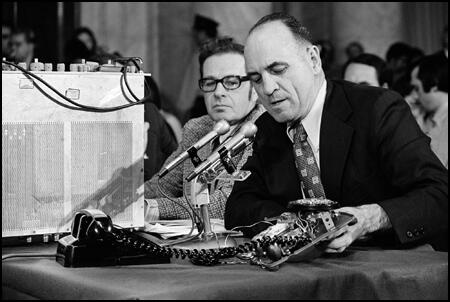
Jim Hougan has pointed out that H. R. Haldeman believed that Butterfield was working for the CIA. William McMahon, a technical security expert who had worked for McCord at the CIA, and later for the Secret Service detachment at the White House, was interviewed by Hougan. McMahon believed that "McCord's seconding of CIA personnel in undercover assignments at the White House amounted to the calculated infiltration of a uniquely sensitive Secret Service unit; the staff responsible for maintain and servicing the presidential taping system and storing its product." Hougan quotes Charles Colson as saying the "CIA had tapes of everything relating to the White House. And they destroyed them two days after Senator Mansfield asked them to save all of their tapes." (77)
As a result of the Nixon tapes, McCord's confessions and investigations by journalists several members of the Nixon administration served time in prison: John N. Mitchell: U.S. Attorney General (19 months); H. R. Haldeman: White House Chief of Staff (18 months); John D. Ehrlichman: Chief Domestic Policy Advisor (18 months); Charles Colson: Special Counsel to the President (7 months); G. Gordon Liddy: Finance counsel for the re-election committee and White House aide (52 months); E. Howard Hunt: White House consultant (33 months); Jeb Stuart Magruder: Deputy director of the re-election committee and White House aide (7 months) and John Dean: White House Legal Counsel (four months). On the brink of impeachment Nixon resigned on 9 August 1974 and was pardoned by his successor, President Gerald R. Ford.
James McCord's sentencing was postponed until June and then postponed again. Finally, in November 1973, McCord was sentenced to one to five years. "I have no regrets in telling the truth," McCord said when he reported to the penitentiary in March 1975. "I think in the long run it's been extremely beneficial to the country to have become aware of what occurred. I was probably the first to tell the truth on Watergate." McCord was released after only four months because of his cooperation in the Watergate investigation. (78)
Douglas Caddy had been wise not to have got involved in distributing "hush money". From what he learnt since he has a theory about the Watergate operation. "The CIA, which had successfully positioned Hunt inside White House, had prior knowledge of the planned break-in. Once the arrest of the burglars occurred, the CIA turned its attention to manipulating the cover-up using Hunt to mount the campaign to get ‘hush' money. I believe the CIA was behind the break-in and assigned Hunt to influence Gordon Liddy to mount it. Its aim was to install a wiretap. The CIA's purpose was to bring down the Nixon presidency because of the threat to it of the Huston Plan and of Nixon's encroachment on the most important intelligence concern of the CIA." (79)
Final Years
For his services as a cooperating witness for federal prosecutors and the Senate Watergate Committee, McCord's sentence - potentially up to 45 years - was reduced to four months He went on to "write a strange, almost-mystical memoir and made a few appearances on panels at conferences marking Watergate anniversaries". But gradually he faded from view, living out his last years in Pennsylvania. (80)
In the years after Watergate, McCord slipped back into anonymity. He changed his firm's name to Security International and later established a solar energy company in Fort Collins, Colorado. McCord's wife, Sarah Berry McCord, died in 2014. (81)
James W. McCord Jr. died June 15, 2017, at his home in Douglassville, Pennsylvania. He was 93. The cause was pancreatic cancer. (82)
Primary Sources
(1) Carl Oglesby, The Yankee and Cowboy War (1976)
Howard Hughes's name surfaced in the story of Watergate on May 20, 1973, when James McCord told the Ervin committee and its media audience of an abandoned 1972 White House plot to steal certain documents from the safe of editor Hank Greenspun's Las Vegas Sun. Greenspun was an ally of Robert Maheu, the top Hughes aide who connected the CIA and the Mafia in 1960, who came to prominence in the Hughes empire during the Las Vegas period, and who then lost out in the Las Vegas power struggle that violently reconfigured the Hughes empire late in 1970. McCord testified that his fellow Plumbers, Hunt and Liddy, were to have carried out the break-in and theft of the papers and that Hughes interests were to have supplied them with a getaway plane and a safe hideout in an unnamed Central American; country.
What could the Greenspun documents have been? Why should both Hughes and Nixon have been interested enough in them to attempt a robbery?
Liddy said (testified McCord) that Attorney General John Mitchell had told him that Greenspun had in his possession blackmail type information involving a Democratic candidate for President, that Mitchell wanted that material, and Liddy said that this information was in some way racketeer-related, indicating that if this candidate became President, the racketeers or national crime syndicate could have a control or influence over him as President. My inclination at this point in time, speaking as of today, is to disbelieve the allegation against the Democratic candidate referred to above and to believe that there was in reality some other motive for wanting to get into Greenspun's safe.
(2) James W. McCord, letter to Jack Caulfield (21st December, 1972)
Jack: Sorry to have to write you this letter but felt you had to know. if Helms goes, and if the WG (Watergate) operation is laid at the CIA's feet, where it does not belong, every tree in the forest will fall. It will be a scorched desert. The whole matter is at the precipice right now. Just pass the message that if they want it to blow, they are on exactly the right course. I'm sorry that you will get hurt in the fallout.
(3) Eugenio Martinez, Harper's Magazine (October, 1974)
All seven of us in McCord's army walked up to the Watergate complex at midnight. McCord rang the bell, and a policeman came and let us in. We all signed the book, and McCord told the man we were going to the Federal Reserve office on the eighth floor. It all seemed funny to me. Eight men going to work at midnight. Imagine, we sat there talking to the police. Then we went up to the eighth floor, walked down to the sixthand do you believe it, we couldn't open that door, and we had to cancel the operation.
I don't believe it has ever been told before, but all the time while we were working on the door, McCord would be going to the eighth floor. It is still a mystery to me what he was doing there. At 2:00 am. I went up to tell - him about our problems, and there I saw him talking to two guards. What happened? I thought. Have we been - caught? No, he knew the guards. So I did not ask questions, but I thought maybe McCord was working there. It was the only thing that made sense. He was the one who led us to the place and it would not have made sense for us to have rooms at the Watergate and go on this operation if there was not someone there on the inside.
(4) Bernard L. Barker, Harper's Magazine (October, 1974)
McCord had the, highest rank of our group in jail then, and so we looked to him for leadership. But we didn't trust him totally, because McCord was very friendly with Alfred Baldwin, and to us; Baldwin was the first informer. To me, Baldwin represented the very lowest form of a human being. McCord was also different from the Cuban group because he did not know about the Ellsberg mission."
After the trial, we were waiting for the sentence in jail, and we were all under tremendous strain. And McCord told me one day: "Bernie, I am not going to jail for these people. If they think they are going to make a patsy out of me they better think again "
So I said, "Jimmy, you are probably a lot more intelligent than I am and you know a lot of things, but ' let's face it. In my way of thinking, you don't do this because of these people. You are going to have to live with McCord, and I am going to have to live with Barker. I don't do this because they are deserving or underserving, but because I have my own code."
Howard (Hunt) was very proud that we had stood up. We had played by the code and not broken. We took everything they had, and it was plenty. The judge sentenced me to forty-five years and the others to long terms, and he told us that our final sentence would be affected by what we told the grand jury and the Watergate Committee, by our cooperation. We were very worried, but we did not let out the Ellsberg thing. We were exposed by the very people who ordered us to do it without their even being in jail.
(5) Andrew St. George, Harper's Magazine (October, 1974)
Both the CIA and the FBI had long known, of course, about the existence of the Hunt-Liddy team. The CIA had infiltrated it with a confidential informant just as if Hunt and Liddy had been foreign diplomats, and the informant, an old Company operative named Eugenio Martinez, code-named "Rolando," who had reported in advance on the Watergate project, was in fact at that moment himself under arrest for his part in the break-in. "Ah, well," Helms said. "They finally did it." He chatted for a few moments with the young watch officer, who said it was "a pity about McCord and some of those guys." "Well, yes," Helms said. "A pity about the President too, you know. They really blew it. The sad thing is, we all think `That's the end of it,' and it may be just the beginning of something worse. If the White House tries to to ring me through central, don't switch it out here, just tell them you reported McCord's arrest already, and I was very surprised."
(6) Lewis Chester, Cal McCrystal and Stephen Aris, Sunday Times (3rd June, 1973)
Under the Senate's diligent scrutiny, McCord has shown an intellectual capacity that belies this image (of a low-level spook).. A memorandum which McCord wrote for his lawyer was described by one Senator with legal training as "a remarkable legal argument." Questioned at an ideological level, McCord said that the consequences of White House pressure on the CIA "smacked of the situation which Hitler's intelligence chiefs found themselves in in the 1930s." One witness, an ex-policeman, Anthony Ulasewicz, thought McCord must be "one of the best wiremen in the business."... A former number two man in the CIA described McCord's job as "highly responsible, requiring great accuracy with details." Allen Dulles, a former CIA chief, is said to have described him as "my top man." McCord knew and liked Dick Helms, another professional who rose to the top of the CIA until Nixon effectively banished him to the ambassadorship of Iran earlier this year.
(7) Jeb Stuart Magruder, An American Life (1974)
"Liddy, what the hell was McCord doing inside the Watergate?" I demanded. "You were supposed to keep this operation removed from us. Have you lost your mind?"
"I had to have somebody on the inside to handle the electronics," Liddy said. "McCord was the only one I could get. You didn't give me enough time."
I couldn't believe it - Liddy was blaming his fiasco on me. But there was no point in arguing with Liddy, so I calmed down and asked him to give me all the facts he had. He explained that the four men arrested with McCord were Cuban "freedom fighters" whom Howard Hunt had recruited in Miami. He said all five men had given false names when arrested, but we had to assume that their true identities would be discovered.
"But don't worry," Liddy told me. "My men will never talk."
I didn't know what to tell Liddy. The situation was beyond my comprehension. I only knew that McCord's arrest was a disaster, because he was CRP's security chief; the Cubans might not even know whom they had been working for, but McCord would be very hard to explain away.
"I've got to talk to Mitchell," I told Liddy. "Stay by the phone. We'll get back to you."
(8) Carl Oglesby, The Yankee and Cowboy War (1976)
Acting FBI Director Patrick Gray told Senator Gurney that "the replacement of the tapes on the Watergate doorlocks" made the FBI consider a double-agent theory. Gurney asked if the matter was investigated and Gray answered, "Can't tell you a thing."
Minority Counsel Fred Thompson to Barker: "Was it McCord who urged you to go ahead despite the fact of discovering that obviously someone had untaped the doors?"
Barker: "Mr. McCord was of this opinion... I, was against entry at that time and, to the best of my recollection, so was Mr. Hunt, my superior. To the best of my knowledge, Mr. Martinez asked if he had taken off the tapes and Mr. McCord replied yes."
Let us spell out the story of these fragments. McCord went inside the Watergate when the doors were still open and cut a piece of tape across the latch on a certain door so that it could not lock. He placed the tape horizontally, so that it showed outside the door. When the entry team arrived at this door hours later expecting to find it thus taped open, they found it shut. The tape had been removed; therefore it must have been discovered, which must have aroused suspicion. The Plumbers then went back across the street to their Howard Johnson's nest to discuss what to do. Everyone but McCord was of a mind to postpone the operation. McCord insisted that they go in anyway and ordered Martinez to pick the lock. Hunt and the Cubans reluctantly went to do so while McCord went someplace else for five minutes, it is not known where or for what purpose. The Cubans left tape on the door for McCord on a faith that one of the world's great intelligence specialists would have presence of mind enough, after all that had happened, to remove the tape behind him so as not to arouse still further the guard certain to return on rounds. McCord neglected to remove this tape when he followed along from his mysterious solitude five minutes later. Martinez was bright enough to ask McCord explicitly if he had remembered the tape, and McCord answered explicitly that he had. Security guard Wills came by, found the door taped open a second time, and notified the police. McCord's acquaintance, Shoffler, was standing by a minute away with his special police unit. He responded instantly.
This sequence of seeming blunders from an evidently accomplished professional that tended uniformly toward a single disastrous result is what aroused one's curiosity about McCord to begin with. The curiosity was not put to rest by the additional incongruity of such accidental details as the early role of McCord's hired man Baldwin in the exposure of the Plumbers' basic relationship to the CRP and the White House.
Nor was it weakened by the unfolding spectacle of McCord's post-Watergate role. Here is an outline of McCord's activity in the post-Watergate period: First, he refused to go along with, and thereby obstructed, a White House plan to make the CIA the Watergate scapegoat. Second, he set up intensive covert contacts with a CIA-Intelligence agent and opened a direct line to Helms, whom he apprised immediately of the White House's every Watergate move as he knew it from the lawyers. Third, he mounted an intense campaign of his own within the Nixon apparatus to intimidate its agents. Fourth, he prepared and carried out (brilliantly) the whole larger, public-education phase of Watergate by means of his thunderbolt of March 19, the letter to Sirica, and his testimony before Ervin. Fifth, at a critical moment, he formed a key relationship with an anti-Nixon attorney.
(9) Carl Oglesby, The Yankee and Cowboy War (1976)
Mitchell was ultimately reached, and he reached for Dean. Mitchell told Dean to use some White House cash to get the Hunt situation settled down. Haldeman came into the picture and told his staff assistant Gordon Strachan to deliver a certain amount, either $40,000 or $70,000. LaRue cranked up his mill and soon got the money on its way through Kalmbach to Ulasewicz to Bittman. There may have been a relaxed moment before information came rippling back from Hunt to Bittman to Ulasewicz to Kalmbach to Mitchell to LaRue to Dean to Haldeman and to Nixon that, even so, the blackmailers were still not satisfied.
Haldeman finally told Strachan to deliver all of $350,000 to CREEP but to get a receipt for it from LaRue. .LaRue accepted the money but refused to write a receipt. LaRue testified to the Watergate committee the following May that paid out a total of about $250,000 to buy Hunt's silence.
December 4 (Monday). Judge Sirica told defense and prosecution attorneys that the jury would want to find out who ordered, who funded, and who organized the Watergate operation.
Early December. Dorothy Hunt complained to McCord that she was tiring of her role in the Watergate blackmail
December 8 (Friday). United Airlines flight 553 inbound from Washington crashed a mile and a half short of Chicago's Midway Airport, where it was trying to land, killing two people on the ground and forty-three of the sixty-one people on the plane. Dorothy Hunt was one of the victims.
(10) Taped conversation between Richard Nixon and John Dean (28th February, 1973)
John Dean: Kalmbach raised some cash.
Richard Nixon: They put that under the cover of a Cuban committee, I suppose?
John Dean: Well, they had a Cuban committee and they - had-some of it was given to Hunt's lawyer, who in turn passed it out. You know, when Hunt's wife was flying to Chicago with $10,000 she was actually, I understand after the fact now, was going to pass that money to one of the Cubans - to meet him in Chicago and pass it to, somebody there.... You've got then, an awful lot of the principals involved who know. Some people's wives know. Mrs. Hunt was the savviest woman in the world. She had the whole picture together.
Richard Nixon: Did she?
John Dean: Yes. Apparently, she was the pillar of strength in that family before the death.
Richard Nixon: Great sadness. As a matter of fact there was discussion with somebody about Hunt's problem on account of his wife and I said, of course commutation could be considered on the basis of his wife's death, and that is the only conversation I ever had in that light.
John Dean: Right. So that is it. That is the extent of the knowledge
(11) John Dean, Blind Ambition: The White House Years (1976)
Chuck Colson said... "I tell you, John... I turned into something of a CIA freak on Watergate for a while, you know, and I still think there's something there. I haven't figured out how it all adds up, but I know one thing: the people with CIA connections sure did better than the rest of us. Paul O'Brien's an old CIA man, and he walked. David Young was Kissinger's CIA liaison, and he ran off to England when he got immunity. Bennett worked for the CIA, and he ran back to Hughes. And Dick Helms skated through the whole thing somehow. Maybe those guys just knew how to play the game better than we did."
(12) Fred Thompson, At That Point in Time (1976) page 170
In my opinion, we (the minority staff) had already determined that the CIA was aware of the activities of the Watergate burglars prior to the break-in and that it perhaps knew more than' that... In my mind, the question was becoming one of whether the CIA had been a participant in or a benign observer of the breakin, or, in view of the bungling of the burglary and the mysterious circumstances surrounding it, whether CIA ' operatives had perhaps sabotaged the break-in to weaken the White House and strengthen the Agency in its struggle for survival.
(13) Bob Woodward memo to Ben Bradlee (16th May, 1973)
Dean talked with Senator Baker after Watergate committee formed and Baker is in the bag completely, reporting back directly to White House...
President threatened Dean personally and said if he ever revealed the national security activities that President would insure he went to jail.
Mitchell started doing covert national and international things early and then involved everyone else. The list is longer than anyone could imagine.
Caulfield met McCord and said that the President "knows that we are meeting and he offers you executive clemency and you'll only have to spend about 11 months in jail."
Caulfield threatened McCord and said "your life is no good in this country if you don't cooperate..."
The covert activities involve the whole U.S. intelligence community and are incredible. Deep Throat refused to give specifics because it is against the law.
The cover-up had little to do with the Watergate, but was mainly to protect the covert operations.
The President himself has been blackmailed. When Hunt became involved, he decided that the conspirators could get some money for this. Hunt started an "extortion" racket of the rankest kind.
Cover-up cost to be about $1 million. Everyone is involved - Haldeman, Ehrlichman, the President, Dean, Mardian, Caulfield and Mitchell. They all had a problem getting the money and couldn't trust anyone, so they started raising money on the outside and chipping in their own personal funds. Mitchell couldn't meet his quota and... they cut Mitchell loose. ...
CIA people can testify that Haldeman and Ehrlichman said that the President orders you to carry this out, meaning the Watergate cover-up... Walters and Helms and maybe others.
Apparently though this is not clear, these guys in the White House were out to make money and a few of them went wild trying.
Dean acted as go-between between Haldeman-Ehrlichman and Mitchell-LaRue.
The documents that Dean has are much more than anyone has imagined and they are quite detailed.
Liddy told Dean that they could shoot him and/or that he would shoot himself, but that he would never talk and always be a good soldier.
Hunt was key to much of the crazy stuff and he used the Watergate arrests to get money... first $100,000 and then kept going back for more...
Unreal atmosphere around the White House - realizing it is curtains on one hand and on the other trying to laugh it off and go on with business. President has had fits of "dangerous" depression.
(14) Lawrence Meyer, Washington Post (31st January, 1973)
Two former officials of President Nixon's re-election committee, G. Gordon Liddy and James W. McCord, Jr. were convicted yesterday of conspiracy, burglary and bugging the Democratic Party's Watergate headquarters.
After 16 days of trial spanning 60 witnesses and more than 100 pieces of evidence, the jury found them guilty of all charges against them in just under 90 minutes.
Chief US District Judge John J. Sirica ordered Liddy, who was also a former White House aide, FBI agent and prosecutor, and McCord, a veteran of the CIA and FBI, jailed without bond. Sirica said he would hold a hearing on bail after defense lawyers file formal written motions.
Lawyers for both Liddy and McCord, said they would appeal the convictions, with McCords's layer attacking the conduct of Judge Sirica during the trial.
Five other men who were indicted with Liddy and McCord, including former White House aide and CIA Agent E. Howard Hunt, Jr. pleaded guilty early in the trial to all charges against them.
Liddy, 42, had maintained a calm, generally smiling exterior throughout the trial. He stood impassive, with is arms folded as deputy court clerk LeCount Patterson read the jury's verdict, repeating six times "guilty" for all eight counts against him.
McCord, 53, also showed no emotion as Patterson read the word "guilty" for all eight counts against him.
Liddy, former finance counsel for the Committee for the Reelection of the President, could receive a maximum sentence of 35 years. McCord, former security director for the committee, could receive a maximum sentence of 45 years. Sirica set no day for sentencing.
Before being jailed by deputy US marshals, Liddy embraced his lawyer, Peter L. Maroulis, patted him on the back, and in a gesture that became his trademark in the trail, gave one final wave to the spectators and press before he was led away.
Principal Assistant US Attorney Earl J. Silbert said, after the verdict was returned, that it was "fair and just."
In his final statement to the jury, Silbert told the eight women and four men that "when people cannot get together for political purposes without fear that their premises will be burglarized, their conversations bugged, their phones tapped...you breed distrust, you breed suspicion, you lost confidence, faith and credibility."
Silbert asked the jury to "bring in a verdict that will help restore the faith in the democratic system that has been so damaged by the conduct of these two defendants and their coconspirators."
Despite repeated attempts by Judge Sirica to find out if anyone else besides the seven defendants was involved in the conspiracy, testimony in the trial was largely confined by the prosecution to proving its case against Liddy and McCord, with occasional mention made of the five who had pleaded guilty. The jury, which was sequestered throughout the trial, was never told of the guilty pleas.
When Hunt pleaded guilty Jan 11, Sirica questioned him in an attempt to find out if anyone besides the persons indicted was involved in the conspiracy.
Hunt's lawyer, William O. Bittman, blocked Sirica's questions, saying the prosecution had told him it intended to call Hunt and any other defendant who was convicted to testify before the grand jury.
An apparent purpose of renewed grand jury testimony would be to probed the involvement of others in the bugging. Asked yesterday what steps he now intended to take, Silbert said, "I don't think I'll comment on anything further."
According to testimony in the trial, Liddy was given about $332,000 in campaign funds purportedly to carry out a number of intelligence-gathering assignments given him by deputy campaign direction Jeb Stuart Magruder.
The prosecution said it could account for only about $50,000 of this money, and that it was used to finance the spying operation against the Democratic Party.
In his argument to the jury, Silbert called Liddy the "mastermind, the boss, the money-man" of the operation.
Maroulis, defending Liddy, attempted to put the blame on Hunt, who Maroulis said was Liddy's trusted friend. "From the evidence here, it can well be inferred that Mr. Liddy got hut by that trust," Maroulis said.
McCord's lawyer, Gerald Alch, told the jury that McCord "is the type of man who is loyal to his country and who does what he thinks is right." At one point, Judge Sirica interrupted and told Alch he was only giving his "personal opinion."
Alch criticized Sirica during a recess, saying the Judge "did not limit himself to acting as a judge-he has become in addition, a prosecutor and an investigator ... Not only does he indicate that the defendants are guilty, but that a lot of other people are guilty. The whole courtroom is permeated with a prejudicial atmosphere."
Alch said that "in 15 years of practicing law" he had not been previously interrupted by a judge while giving his final argument.
McCord and Liddy were each convicted of the following counts:
Conspiring to burglarize, wiretap and electronically eavesdrop on the Democratic Party's Watergate headquarters. (Maximum penalty-five years' Imprisonment and a $10,000 fine.)
Burglarizing the Democratic headquarters with the intent to steal the property of another. (Maximum penalty-15 years imprisonment.)
Buglarizing the Democratic headquarters with the intent to unlawfully wiretap and eavesdrop. (Maximum penalty-15 years.)
Endeavoring to eavesdrop illegally. (Maximum penalty-five years' imprisonment and a $10,000 fine.)
In addition, McCord was convicted of two additional counts:
Possession of a device primarily useful for the surreptitious interception or oral communications. (Maximum penalty-five years' imprisonment and a $10,000 fine).
Possession of a device primarily useful for the surreptitious interception of wire communications. (Maximum penalty-five years' imprisonment and a $10,000 fine).
Although the total number of years Liddy could be sentenced to adds up to 50 and McCord's total sentence adds up to 60 years, neither, according to legal sources, can receive consecutive sentences for both burglary counts.
As a result, Liddy's maximum sentence could be 35 years and a $40,.000 fine and McCord's maximum could be 45 years and $60,000 fine.
In addition to Liddy, McCord and Hunt, four men from Miami were named in the indictment - Bernard L. Barker, Frank Sturgis, Virgilio R. Gonzalez and Eugenio R. Martinez.
All four pleaded guilty Jan. 15 to the seven counts with which they were charged.
They face maximum sentences of 40 years in jail and fines of $50,000. The four men were arrested, with McCord, by Washington police in the Democratic Party headquarters at 2:30 a.m. on June 17. The arrests marked the beginning of the Watergate affair.
These five men, dressed in business suits and wearing rubber surgical gloves, had electronic bugging equipment and sophisticated cameras in film. In their possession or their rooms they had $5,300 in $100 bills.
The story unfolded slowly. The day after the arrests, it was learned that one of the five men was the security coordinator for the President's reelection committee. That was McCord, one of the two defendants left in the Watergate trial yesterday.
Two days after the break-in White House consultant Hunt was linked to the five suspects. Hunt pleaded guilty to all counts in the opening days of the trial.
Near the end of July, it was learned that the finance counsel to the Nixon Reelection Committee was fired because he refused to answer FBI questions about the Watergate bugging and break-in. The counsel was Liddy, a former Treasury and White House aide who was the other defendant to remain in the trial.
On Aug. 1, The Washington Post reported that a $25,000 cashier's check intended as a contribution tot he Nixon reelection effort has been deposited in the Miami bank account of one of the Watergate suspects. The General Accounting Office, the investigative arm of Congress, ordered an immediate audit of the Nixon campaign finances.
The audit report concluded that former Commerce Secretary Maurice H. Stans, the chief Nixon fund-raiser, has a possible illegal cash fund of $350,000 in his office safe.
The $25,000 from the cashier's check and another $89,000 from four Mexican checks passed through that fund, the GAO concluded.
Last Friday, the Finance Committee to Re-elect the President pleaded no contest in US District Court to eight violations of the campaign finances law. The complaint charged, among other things, that finance committee officials filed to keep adequate records of payments to Liddy. The committee was fined $8,000.
In September, reports surfaced that a former FBI agent and self-described participant in the bugging had become a government witness in the case. He was Alfred C. Baldwin III, who later was to testify that he monitored wire-tapped conversations for three weeks from a listening post in the Howard Johnson Motor Lodge across the street from the Watergate.
On Sept. 15, the federal indictment against the seven original defendants was returned.
The next day, The Post reported that the $350,000 cash fund kept in the Stans safe was used, in part, as an intelligent - gathering fund. On Sept. 29, The Post reported that sources close to the Watergate investigation said that former Attorney General John N. Mitchell controlled disbursements from the intelligence found or so-called "secret fund."
On Oct. 10, The Post reported that the FBI had concluded that the Watergate bugging was just one incident in a campaign of political sabotage directed by the White House and the Nixon committee.
The story identified Donald H. Segretti, a young California lawyer, as a paid political spy who traveled around the country recruiting others and disrupting the campaigns of Democratic presidential contenders.
Five days later, the President's appointments secretary, Dwight L. Chapin, was identified as a person who hire Segretti and received reports from him. Segretti's other contact was Watergate defendant Hunt. Segretti received about $35,000 in pay for the disruptive activities from Herbert W. Kalmbach, the President's personal attorney, according to federal investigators.
This Monday it was announced that Chapin was resigning his White House job. Segretti was not called as a witness in the trial.
(15) Bob Woodward and Carl Bernstein, Washington Post (13th June, 1973)
The Watergate prosecutors have a one-page memo addressed to former White house domestic affairs adviser John D. Ehrlichman that described in detail the plans to burglarize the office of Pentagon papers defendant Daniel Ellsberg's psychiatrist, according to government sources.
The memo sent to Ehrlichman by former White House aides David Young and Egil (Bud) Krogh, was dated before the Sept. 3, 1971 burglary of the office of the Beverly Hills psychiatrist, the sources said.
The memo was turned over to the prosecutors by Young, who has been granted immunity from prosecution, the sources said.
The sources confirmed earlier reports that Young will testify that Ehrlichman saw the memo and approved the burglary operation.
Ehrlichman could not be reached directly for comment yesterday, but Frank H. Strickler, one of his attorneys, said: "It has been his consistent position that he had no advance knowledge of the break-in and Mr. Ehrlichman stands by that position."
The burglary was supervised by Watergate conspirators E. Howard Hunt, Jr. and G. Gordon Liddy, who in 1971 were members of the White House special investigations unit called the "plumbers."
The group which was directed by Young and Krogh, was charged with investigating leaks to the news media and had been established in June, 1971, after the publication of the Pentagon Papers by several newspapers.
The memo from Krogh and Young directly contradicts a statement Ehrlichman made to the FBI on April 27. According to a summary of that interview made public May 2, Ehrlichman stated that he "was not told that these individuals (Hunt and Liddy) had broken into the premises of the psychiatrist for Ellsberg until after this incident had taken place. Such activity was not authorized by him, he did not know about this burglary until after it had happened."
In an affidavit released last month, Krogh had given "general authorization to engage in covert activity" to obtain information on Ellsberg.
Reliable sources said that Krogh prepared his affidavit by referring to an incomplete copy of the memo that he and Young sent to Ehrlichman before the burglary. Missing from that copy, the sources said, was the bottom portion in which plans for the burglary were described.
The top portion merely made a general reference to covert activity and Krogh based his affidavit on that, according to the sources.
The sources said the prosecutors have the entire memo and that Krogh, now reminded of its contents, is expected to change his statement, thus adding to the damaging testimony against Ehrlichman.
The sources said that the bottom portion of the memo was apparently removed late last year or early this year to sanitize Korgh's files before Senate confirmation hearings on his nomination as undersecretary of Transportation.
Krogh was confirmed without difficulty. He resigned last month after acknowledging that he approved the burglary operation on Ellsberg's psychiatrist.
(16) Bob Woodward and Carl Bernstein, All the President's Men (1974)
On Wednesday, March 28, McCord was scheduled to give his first sworn testimony behind closed doors to the seven Senators on the Watergate committee. Bernstein joined dozens of reporters waiting outside the hearing room. The reporters began discussing "leaks" which were bound to come out, and agreed on the dangers of trying to report what would go on inside. It was no longer a matter of "investigative" reporting - evaluating information, putting together pieces in a puzzle, disclosing what had been obscured. They would be merely trying to find out in advance the testimony of witnesses who would eventually take the stand in public. Judging which allegations were hearsay, which first-hand knowledge, and placing them in context would be difficult. Sensational charges and deliberate leaks by interested parties would be hard to evaluate. If some papers or networks searched out leaks, all the reporters would feel bound to compete.
The committee session with McCord lasted four and a half hours. Afterward, Senator Howard Baker of Tennessee, the Republican vice chairman of the committee, announced that McCord had provided "significant information... covering a lot of territory."
Bernstein and Woodward began the ritual phone calls, starting with the Senators. "Okay, I'm going to help you on this one," one told Woodward. "McCord testified that Liddy told him the plans and budget for the Watergate operation were approved by Mitchell in February, when he was still Attorney General. And he said that Colson knew about Watergate in advance."
But, in answer to Woodward's questions, be added that McCord had only secondhand information for his allegations, as well as for his earlier accusations that Dean and Magruder had had prior knowledge.
"However," the Senator said, "he was very convincing."
Bradlee was able to get a second Senator to corroborate the story, and Bernstein received the same version from a staff member.
The next day's story, though calling attention to the hearsay nature of McCord's testimony, quoted the unnamed Senator's evaluation.
The flood of "McCord says" stories continued. McCord appeared again on Thursday, and the reporters went through the same exercise. McCord stated that Liddy had told him that charts outlining the Watergate operation had been shown to Mitchell in February. Three sources gave identical versions of the testimony.
(17) Carl Oglesby, The Yankee and Cowboy War (1976)
There is a simple ambiguity to this term "Watergate operation," which I sense the honest McCord plays on to keep from lying as he misleads us about this. If by Watergate operation we mean the break-in at the DNC, then we can completely agree with McCord. It was not the Helms CIA that conceived this and carried it out. It was the Nixon White House. It is only incidental in this respect that except for Liddy, formerly of the FBI, all the bagmen had Agency backgrounds and active Agency contacts. Incidental. These people will have been merely moonlighting.
But the Watergate operation can also mean the arrest, the capture of the Nixon men at their work in the DNC redhanded. It is in this sense that I say the Nixon people were right, Watergate was a plot and Nixon was undone, by a component of the CIA he had not been able to bring under White House control. Just as with Kennedy a decade before, only in political reverse.
Thus, the theory we are about to pursue: that McCord was the pointman of an anti-Nixon plot formed within the CIA whose purpose was to disrupt a larger White House plot 'having police-state ramifications. This theory is based on analysis of five factors: (1),an indication that whispers of an Impending anti-Nixon plot were circulating before Watergate; (2) the denunciation of McCord by his confederate Plumbers; (3) direct evidence of a still-concealed CIA involvement in Watergate; (4) intimations of Yankeehood in McCord's career; and (5) McCord's overall role in the development of Watergate as a public issue.
(18) James McCord was interviewed by Daniel Schultz on 17th December, 1976.
A false allegation was made shortly after March 23, 1973, that E. Howard Hunt and Frank Sturgis were in Dallas at the time the President was killed, and a photograph was circulated purporting to be Hunt and Sturgis there at the time. Persons I know circulated and touted the story to the press, knowing the allegation was false in its entirety, and further that the men in the photographs bore no resemblance whatever to Hunt and Sturgis. I know that Hunt was not in Dallas and had no connection whatever with the President's death...Great anguish and damage has been done to Hunt, and no doubt will be taken into consideration by a parole board considering his release from prison.
(19) John Simkin, Bernard L. Barker (16th July, 2005)
One of the things that has always intrigued me is the large number of mistakes that were made during the Watergate operation. This is in direct contrast to other Nixon dirty tricks campaigns. Some people have speculated that there were individuals inside the operation who wanted to do harm to Nixon. I thought it might be a good idea to list these 24 “mistakes” to see if we can identify these individuals. Could it have been Bernard Barker?
(1) The money to pay for the Watergate operation came from CREEP. It would have been possible to have found a way of transferring this money to the Watergate burglars without it being traceable back to CREEP. For example, see how Tony Ulasewicz got his money from Nixon. As counsel for the Finance Committee to Re-Elect the President, Gordon Liddy, acquired two cheques that amounted to $114,000. This money came from an illegal U.S. corporate contribution laundered in Mexico and Dwayne Andreas, a Democrat who was a secret Nixon supporter. Liddy handed these cheques to E. Howard Hunt. He then gave these cheques to Bernard Barker who paid them into his own bank account. In this way it was possible to link Nixon with a Watergate burglar.
(2) On 22nd May, 1972, James McCord booked Alfred Baldwin and himself into the Howard Johnson Motor Inn opposite the Watergate building (room 419). The room was booked in the name of McCord’s company. During his stay in this room Baldwin made several long-distance phone calls to his parents. This information was later used during the trial of the Watergate burglars.
(3) On the eve of the first Watergate break-in the team had a meeting in the Howard Johnson Motor Inn’s Continental Room. The booking was made on the stationary of a Miami firm that included Bernard Barker among its directors. Again, this was easily traceable.
(4) In the first Watergate break-in the target was Larry O’Brien’s office. In fact, they actually entered the office of Spencer Oliver, the chairman of the association of Democratic state chairman. Two bugs were placed in two phones in order to record the telephone conversations of O’Brien. In fact, O’Brien never used this office telephone.
(5) E. Howard Hunt was in charge of photographing documents found in the DNC offices. The two rolls of film were supposed to be developed by a friend of James McCord. This did not happen and eventually Hunt took the film to Miami for Bernard Barker to deal with. Barker had them developed by Rich’s Camera Shop. Once again the conspirators were providing evidence of being involved in the Watergate break-in.
(6) The developed prints showed gloved hands holding them down and a shag rug in the background. There was no shag rug in the DNC offices. Therefore it seems the Democratic Party documents must have been taken away from the office to be photographed. McCord later claimed that he cannot remember details of the photographing of the documents. Liddy and Jeb Magruder saw them before being put in John Mitchell’s desk (they were shredded during the cover-up operation).
(7) After the break-in Alfred Baldwin and James McCord moved to room 723 of the Howard Johnson Motor Inn in order to get a better view of the DNC offices. It became Baldwin’s job to eavesdrop the phone calls. Over the next 20 days Baldwin listened to over 200 phone calls. These were not recorded. Baldwin made notes and typed up summaries. Nor did Baldwin listen to all phone calls coming in. For example, he took his meals outside his room. Any phone calls taking place at this time would have been missed.
(8) It soon became clear that the bug on one of the phones installed by McCord was not working. As a result of the defective bug, McCord decided that they would have to break-in to the Watergate office. He also heard that a representative of the Vietnam Veterans Against the War had a desk at the DNC. McCord argued that it was worth going in to see what they could discover about the anti-war activists. Liddy later claimed that the real reason for the second break-in was “to find out what O’Brien had of a derogatory nature about us, not for us to get something on him.”
(9) Liddy drove his distinctive Buick-powered green Jeep into Washington on the night of the second Watergate break-in. He was stopped by a policeman after jumping a yellow light. He was let off with a warning. He parked his car right outside the Watergate building.
(10) The burglars then met up in room 214 before the break-in. Liddy gave each man between $200 and $800 in $100 bills with serial numbers close in sequence. McCord gave out six walkie-talkies. Two of these did not work (dead batteries).
(11) McCord taped the 6th, 8th and 9th floor stairwell doors and the garage level door. Later it was reported that the tape on the garage–level lock was gone. Hunt argued that a guard must have done this and suggested the operation should be aborted. Liddy and McCord argued that the operation must continue. McCord then went back an re-taped the garage-level door. Later the police pointed out that there was no need to tape the door as it opened from that side without a key. The tape served only as a sign to the police that there had been a break-in.
(12) McCord later claimed that after the break-in he removed the tape on all the doors. This was not true and soon after midnight the security guard, Frank Wills, discovered that several doors had been taped to stay unlocked. He told his superior about this but it was not until 1.47 a.m. that he notified the police.
(13) The burglars heard footsteps coming up the stairwell. Bernard Barker turned off the walkie-talkie (it was making a slight noise). Alfred Baldwin was watching events from his hotel room. When he saw the police walking up the stairwell steps he radioed a warning. However, as the walkie-talkie was turned off, the burglars remained unaware of the arrival of the police.
(14) When arrested Bernard Barker had his hotel key in his pocket (314). This enabled the police to find traceable material in Barker’s hotel room.
(15) When Hunt and Liddy realised that the burglars had been arrested, they attempted to remove traceable material from their hotel room (214). However, they left a briefcase containing $4,600. The money was in hundred dollar bills in sequential serial numbers that linked to the money found on the Watergate burglars.
(16) When Hunt arrived at Baldwin’s hotel room he made a phone call to Douglas Caddy, a lawyer who had worked with him at Mullen Company (a CIA front organization). Baldwin heard him discussing money, bail and bonds.
(17) Hunt told Baldwin to load McCord’s van with the listening post equipment and the Gemstone file and drive it to McCord’s house in Rockville. Surprisingly, the FBI did not order a search of McCord’s home and so they did not discover the contents of the van.
(18) It was vitally important to get McCord’s release from prison before it was discovered his links with the CIA. However, Hunt or Liddy made no attempt to contact people like Mitchell who could have organized this via Robert Mardian or Richard Kleindienst. Hunt later blamed Liddy for this as he assumed he would have phoned the White House or the Justice Department who would in turn have contacted the D.C. police chief in order to get the men released.
(19) Hunt went to his White House office where he placed a collection of incriminating materials (McCord’s electronic gear, address books, notebooks, etc.) in his safe. The safe also contained a revolver and documents on Daniel Ellsberg, Edward Kennedy and State Department memos. Hunt once again phoned Caddy from his office.
(20) Liddy eventually contacts Magruder via the White House switchboard. This was later used to link Liddy and Magruder to the break-in.
(21) Later that day Jeb Magruder told Hugh Sloan, the FCRP treasurer, that: “Our boys got caught last night. It was my mistake and I used someone from here, something I told them I’d never do.”
(22) Police took an address book from Bernard Barker. It contained the notation “WH HH” and Howard Hunt’s telephone number.
(23) Police took an address book from Eugenio Martinez. It contained the notation “H. Hunt WH” and Howard Hunt’s telephone number. He also had cheque for $6.36 signed by E. Howard Hunt.
(24) Alfred Baldwin told his story to a lawyer called John Cassidento, a strong supporter of the Democratic Party. He did not tell the authorities but did pass this information onto Larry O’Brien. The Democrats now knew that people like E. Howard Hunt and Gordon Liddy were involved in the Watergate break-in.
Several individuals seem to have made a lot of mistakes. The biggest offenders were Hunt (8), McCord (7), Liddy (6), Barker (6) and Baldwin (3). McCord’s mistakes were the most serious. He was also the one who first confessed to what had taken place at Watergate.
Before this scandal has run its course, other opportunists such as the hypocritical Christian leader Ralph Reed and his cohorts will be exposed for sacrificing the public good for their personal gain.